Abilities: Cleaver, Haste and Blink
Cleaver Duel gives each player exactly three tools: one attack and two once-per-round escapes. This guide covers the exact numbers behind each of them and how those numbers change the decisions you make.
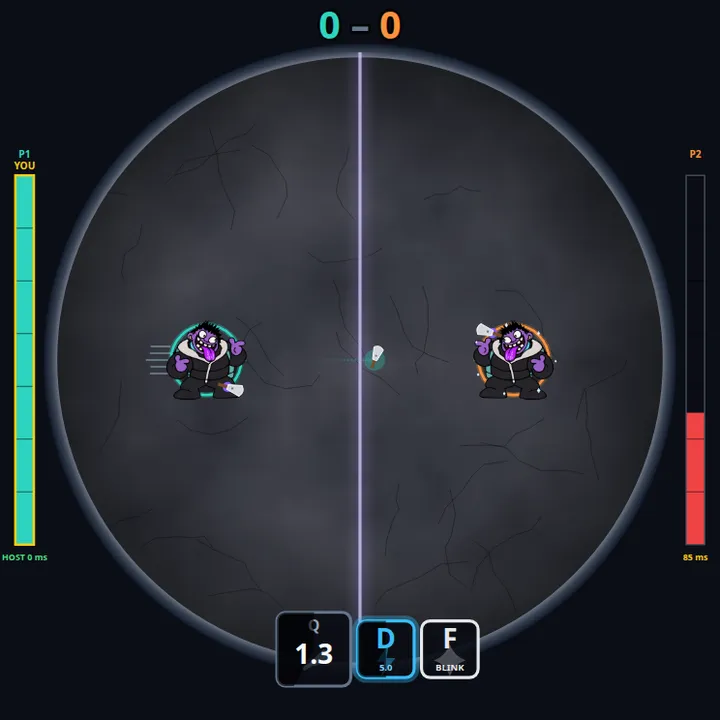
At a glance
| Ability | Default key | Touch | Effect | Limit |
|---|---|---|---|---|
| Cleaver | Q | Q button, then tap | 100 damage, 10% slow for 1 s | 3 s cooldown, 0.18 s wind-up |
| Haste | D | D button | +40% movement speed for 10 s | Once per round |
| Blink | F | F button, then tap | Teleport up to 350 units toward the target | Once per round |
| Stop | S | S button | Stops moving, cancels a wind-up for free | None |
Cleaver: the only way to win
Everything in the game exists to land cleavers. Each one deals 100 damage out of a 700 HP pool, so a round is exactly seven hits for the winner, with no healing and no armor. A cleaver flies at 1,400 units per second, and the arena is 1,000 units across, so a cleaver thrown from one edge to the other takes roughly 0.7 seconds to arrive.
Before it leaves your hand there is a short wind-up of 0.18 seconds during which you are rooted in place. That is long enough to be punished by an opponent who has a clear shot, but short enough that you can throw safely whenever the enemy cleaver is on cooldown. After the throw the 3-second cooldown starts, which is the main rhythm of every duel: you throw, you move, and you wait for the icon to come back.
A hit also slows the victim by 10% for one second. That sounds small, but at roughly 345 units per second of base speed it costs about 35 units of movement over the slow, which is often the difference between sidestepping the next cleaver and eating it.
Dodging maths
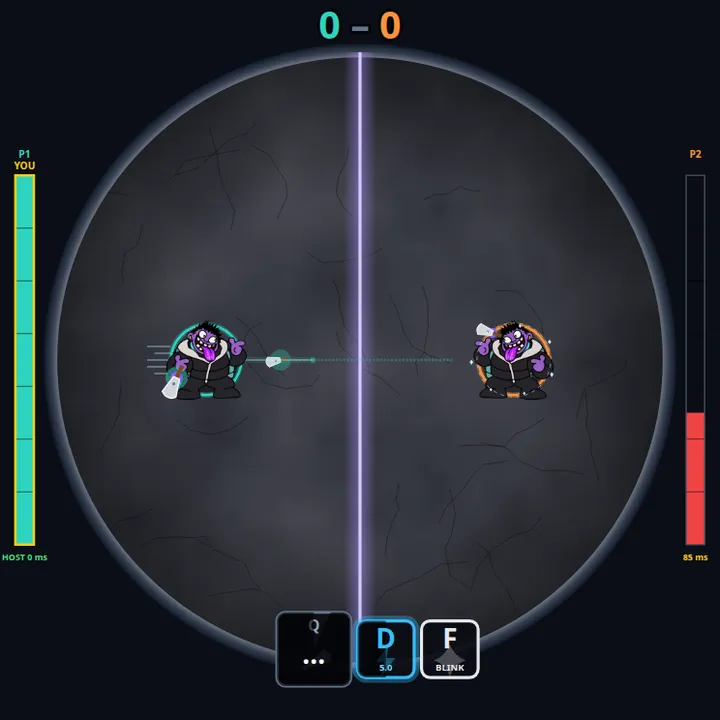
The cleaver is hit-tested with a swept collision between a brute of radius 54 and a cleaver of radius 18, so you must get roughly 72 units out of its line to avoid it. At the starting positions the two brutes are 500 units apart and the cleaver needs about 0.36 seconds to arrive. Walking sideways at 345 units per second covers about 123 units in that time, which is plenty. Closer than about 250 units the cleaver arrives in under 0.18 seconds, and you can no longer walk out of the way: you either need Blink, or you needed to move before the throw.
Haste: the closer and the escape
Haste raises your speed from about 345 to about 484 units per second for 10 seconds. Because you only get one per round, it is a commitment. Players tend to use it in one of three ways:
- To close the gap after landing a hit, so the slowed opponent cannot get away before your cooldown is back.
- To escape a bad position, such as being pinned against the outer wall while the enemy cleaver is ready.
- To win the centre when the wall falls in sudden death.
Haste has no wind-up and it does not cancel your move order, so you can press it in the middle of a dodge without losing your path. On touch devices it fires immediately from the D button, with no target.
Blink: the defensive trump card
Blink teleports you up to 350 units toward your target, instantly. That is about one full second of walking compressed into a single frame. Two rules matter: Blink clears your current move order, so you stand still where you land, and it cannot be used during the cleaver wind-up. If you press it while rooted, the game queues it and fires it the moment the wind-up finishes, which makes a throw-then-vanish combination possible.
On a touchscreen Blink works the same way as the cleaver: tap the F button, then tap the arena where you want to land.
Stop: the free cancel
Stop is not a limited ability, but it matters. It cancels a cleaver wind-up without spending the cooldown. That lets you fake a throw, see whether your opponent flinches, and cancel to keep your cooldown available.
Reading the ability icons
The ability bar at the bottom of the arena shows the cleaver cooldown as a countdown and shows Haste and Blink as ready or used. Watch your opponent's icons too: the rival's cleaver cooldown is the most important number on screen, because it tells you when you are safe to stand still.